Quick Reference
Background
Custers, of whom there were five in the 7th Cavalry, lived as a clan, fought as a clique, and died in their matching white buckskins at the Battle of the Little Bighorn on the same afternoon. When Ronald Reagan, a self-confessed “Custer buff," asserted that the flamboyant general was a brilliant officer, he was dead-on: Custer was one of the best cavalry officers, if not the best, in the United States Army. But what made him so was, to no small extent, his absolute and single-minded love of the chase. In pursuit, every consideration but one flew from him - and when, on June 25, 1876, victory finally eluded him, at the Battle of the Little Bighorn, he died fighting, along with his entire command. Among the 268 dead were Custer’s nephew Armstrong "Autie" Reed, his brother-in-law James Calhoun, his younger brother Tom and his youngest brother, Boston.
Here, Custer lobbies for a second lieutenancy for his beloved kid brother “Bos":
I am extremely anxious to obtain an appointment from the Secretary of War of my youngest brother Boston Custer as second lieutenant in the 7th Cavalry. My brother is in every respect admirably adapted to perform the duties of a cavalry officer. He is nearly twenty four years of age, of excellent habits and character and I think would be a credit to the service.
Boston Custer was not appointed a Second Lieutenant, or even accepted, however, into the United States Army. He was frail and tubercular, and not, despite his brother’s pleading “in every respect admirably adapted to perform the duties of a cavalry officer.” So Custer hired him as scout, at a hundred dollars a month, and happily took him along on his first, and last, campaign. “I don't know what we would do,” Custer wrote from the trail, “without ‘Bos’ to tease…”
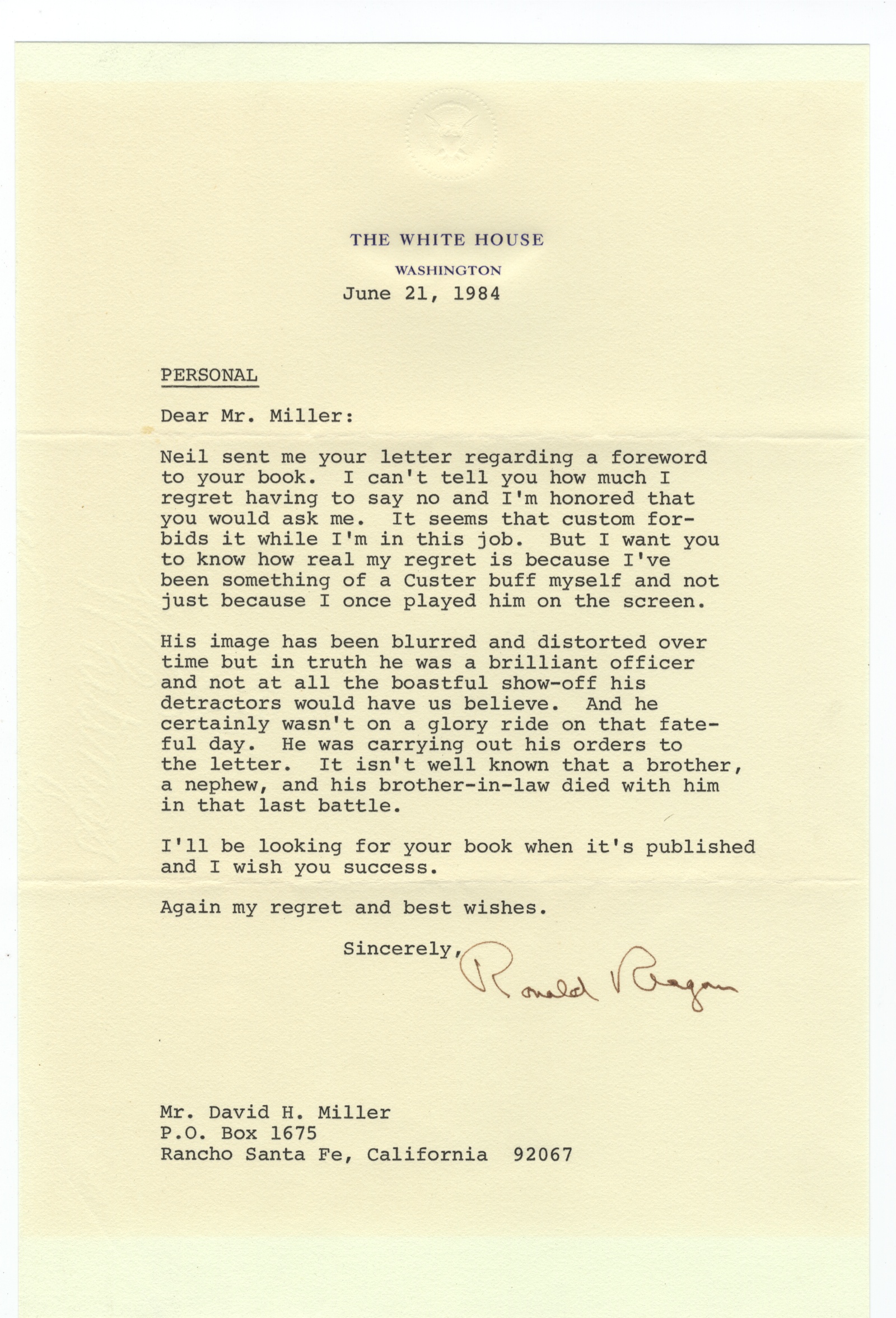
Patrolling the Plains had been, for the Custers, a frolic and a lark – right up to the moment on Last Stand Hill when, some posit, Tom shot his mortally-wounded brother, George, through the temple, lest he be tortured to death. His own body, bristling with arrows, was found close by – as were Boston’s and Autie’s. Brother-in-law James, too, lay a bit farther away. This terrible testament to love and loyalty is why, in fact, Ronald Reagan wrote in a 1984 letter to a Western historian, that he never believed Custer was a swashbuckler who, knowingly, would have placed members of his own family in harm’s way.
But miscalculate he did, underestimating the size of the Indian village, and splitting up his forces. And for all the millions of words written about the Battle of the Little Bighorn, oddly, this is an unusual, and even novel, thesis. It may be true. The Custer clan died as they lived – together.
Physical Description
all pages and transcript
Page 1/3
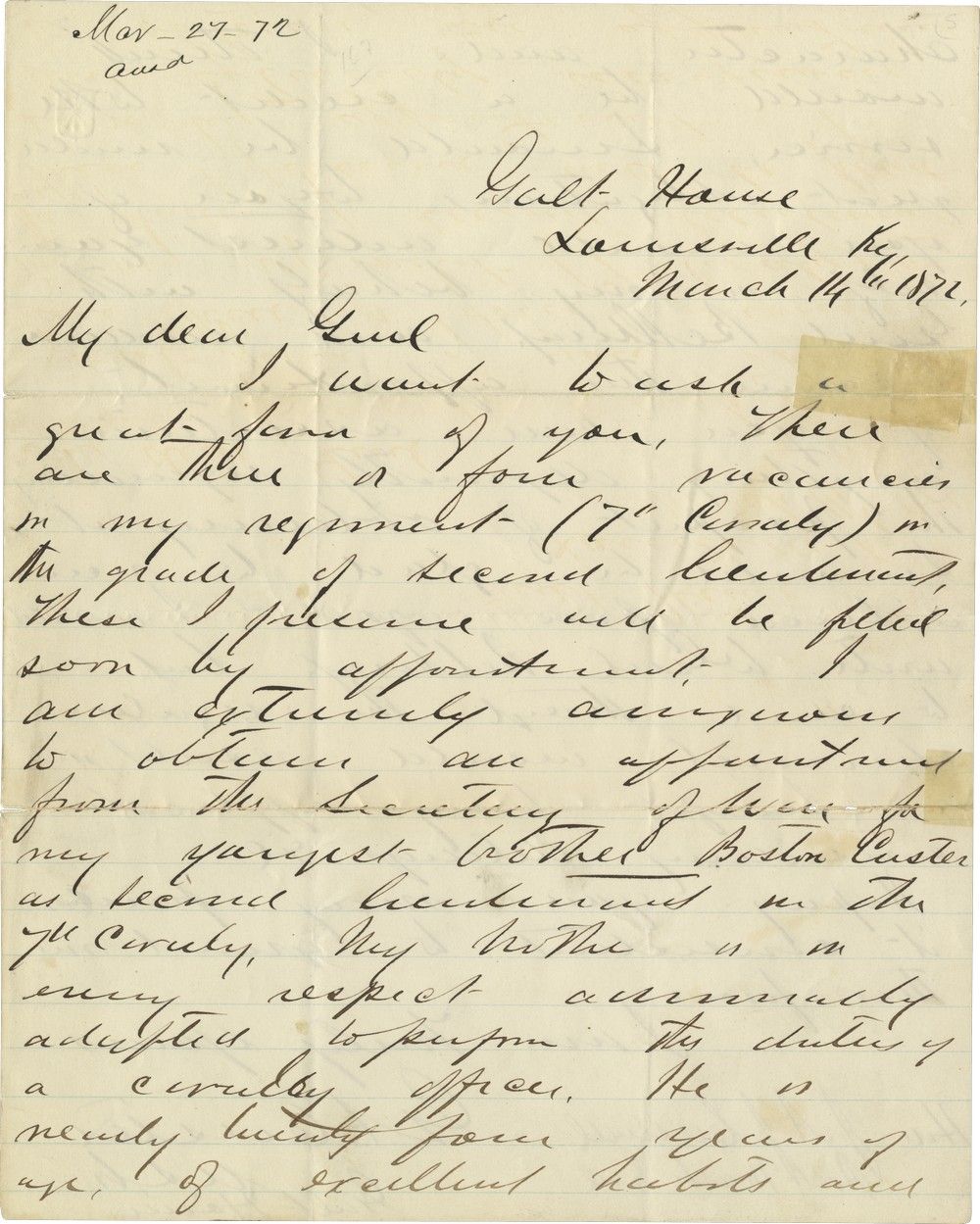
ansd [sic]
Galt House
March 14th 1872.
My dear Genl
Page 2/3
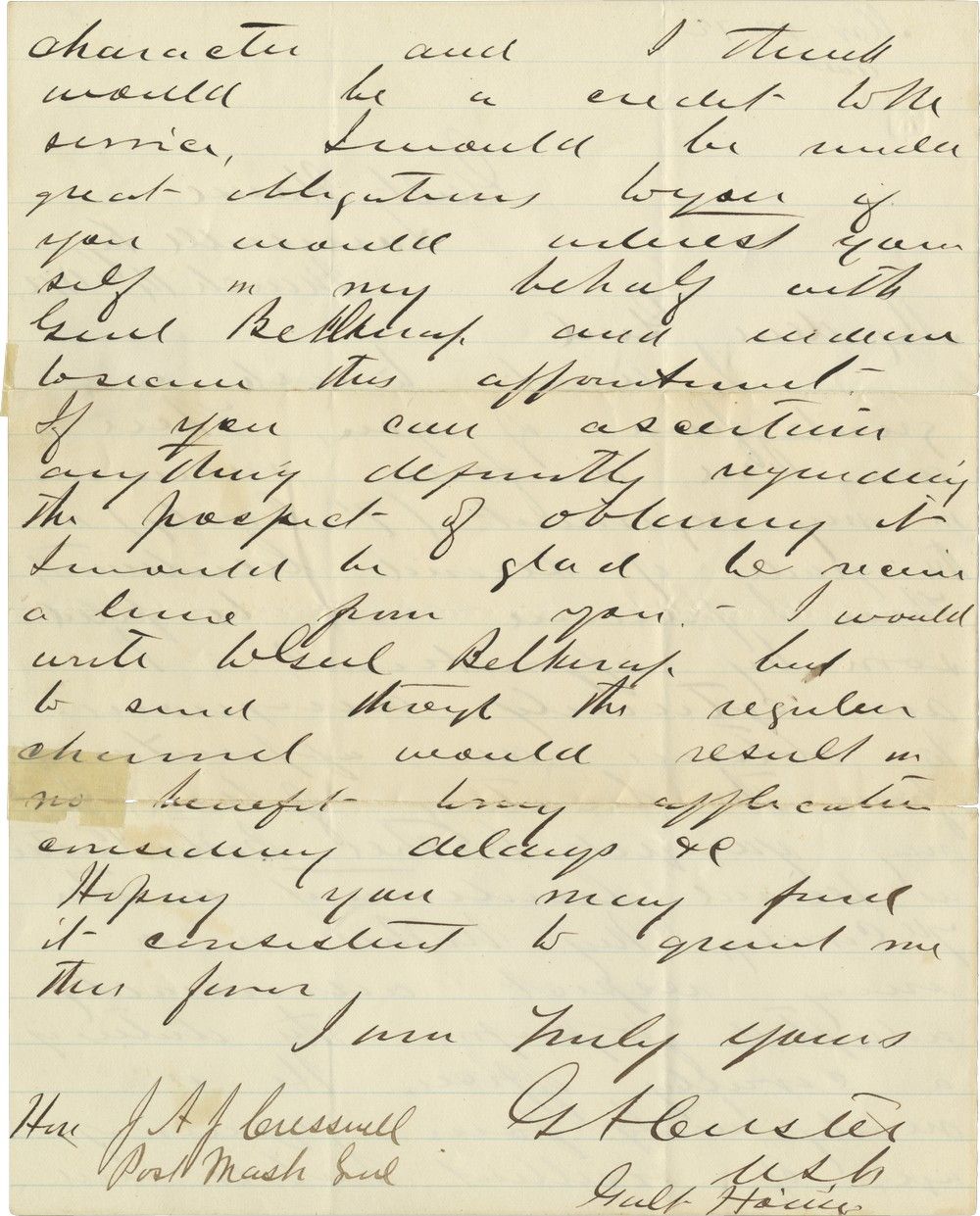
If you can ascertain anything definitely regarding the prospect of obtaining it I would be glad to receive a line from you. -- I would write to Genl Belknap but to send through the regular channel would result in no benefit to my application considering delays &c
Hoping you may find it consistent to grant me this favor
I am Truly yours
G A CUSTER
U S A
Galt House
Hon J A J Cresswell
Post Master Genl
Page 3/3
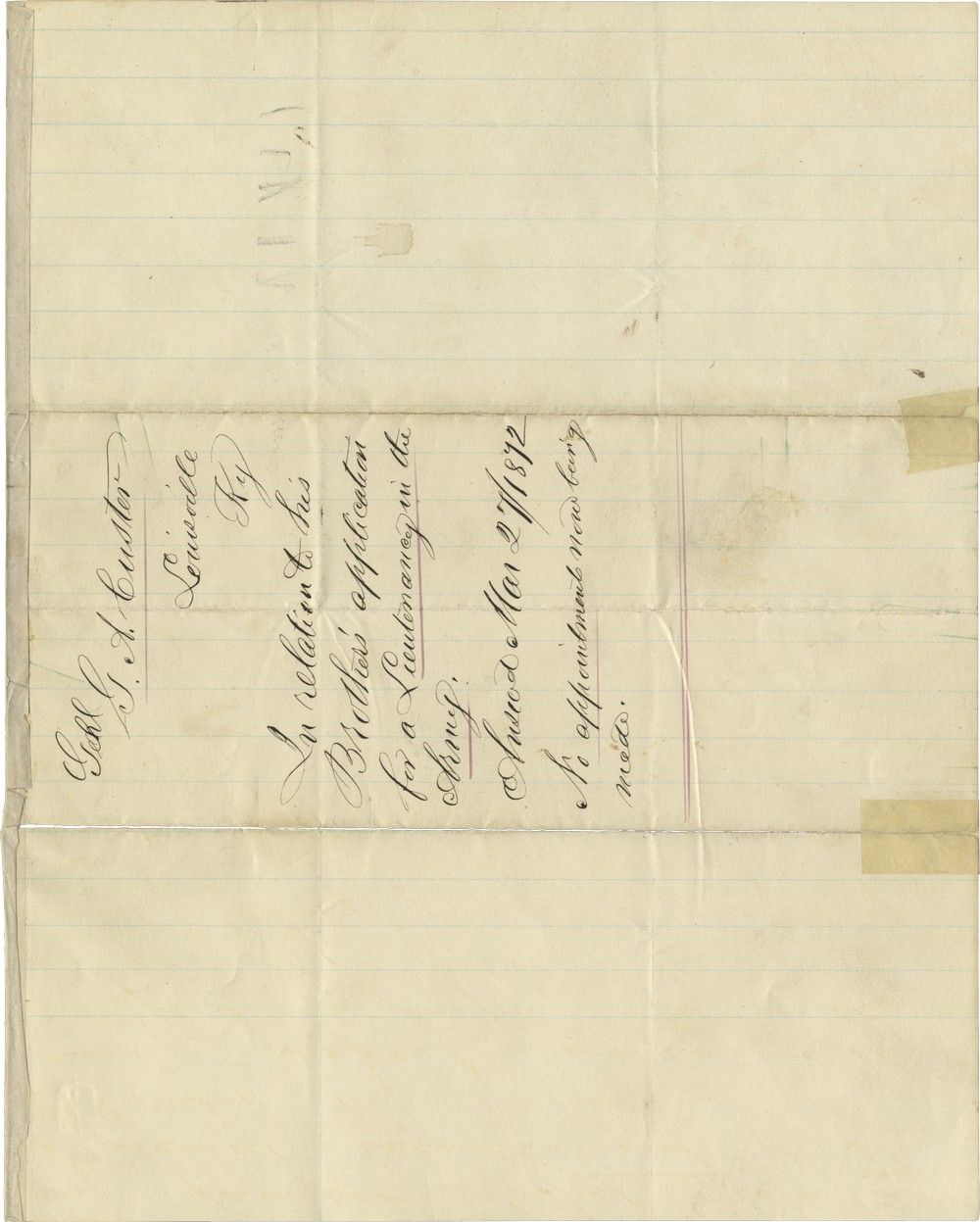
Louisville
Ky
In relation to his
Brother's application
for a Lieutenancy in the
Army:
Answd [sic] Mar 27/1872
No appointments now being
made.